Perugia is a gem of a city that conquers and attracts tourists from all over the world. The historic center of the Umbrian capital is a real fourteenth-century village, one of the most beautiful and loved in Italy. The Umbrian town holds artistic and monumental treasures that testify its rich past and do justice to the cultural primacy of our country. It boasts a very intense city life, linked to the presence of the two historic universities, the Università degli Studi founded in 1308, and the University for Foreigners, the largest in Italy. Various international events are organized in the city, such as Eurochocolate and Umbria Jazz.
Perugia deserves much more than a hit-and-run visit to discover its most important monuments; it is also the perfect destination for an extended holiday.
How to arrive in Perugia
Perugia is well connected with trains and buses. You have many convenient choices:
-If you decide to arrive at S. Francesco D’Assisi airport in Perugia, and you are thinking of staying in a hotel in the center of Perugia, you can easily rent a car and arrive in the city in 19 minutes.
-If you are staying in Assisi, as we did, or in other towns nearby, then it’s more convenient to take a train. We visited Perugia in an afternoon, after we came back from the Perugina Chocolate House, that is situated in San Sisto, from there we got a city bus that brought us, in 15 minutes, to the center of Perugia.
What to see in Perugia
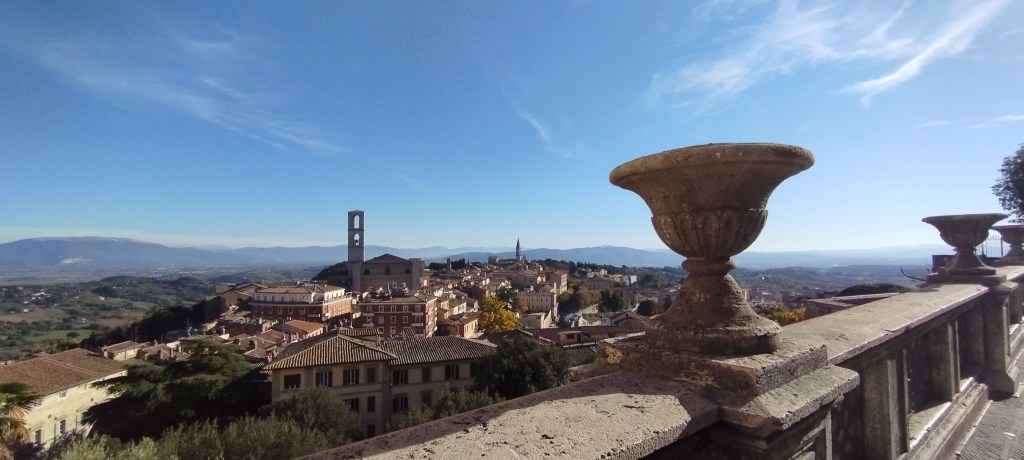
As soon as we arrived at the center of Perugia, we were captured by a stunnning view, that struck and left us speechless. Walking on the sidewalk we were absorbed by a breathtaking view, everywhere we looked. Perugia is surrounded by hills, mountains, and plains of surprising attraction. The city is simply one of a kind, and you cannot help but immortalize such beauty! The alternation of different cultures and people has been a blessing for those who are lucky enough to visit Perugia today.
Casa del Cioccolato
The first mention goes absolutely to the Perugina Chocolate House, a must-see for all those with a desire and love for sweets, for families, children, and people of all ages. The ticket costs 10 euro per person, and a reservation is required. It houses the museum that traces the history of the “food of the Gods”. On November 30th,1907 in Perugia, Francesco Buitoni, Leone Ascoli, Francesco Andreani, and Annibale Spagnoli set up a confetti workshop destined to become an industry, La Società Perugina, for the production of sugared almonds. In 2007, during the occasion of Perugina’s centenary, the Perugina Chocolotate House was born. It is a unique place in the world, where you can take an exciting journey, from the Museum to visiting the Factory, up to the Chocolate School, where you can follow the courses of the Master Pastry Chefs and create small masterpieces of goodness. This is only a brief explanation, a more detailed article will be written soon!

Piazza IV Novembre
It’s time to get closer to the beating heart of the city, Piazza IV Novembre with the Fontana Maggiore. Here you can see the Palazzo dei Priori and the Cathedral of San Lorenzo. Just sit on the steps, enjoy the view, watch the coming and going of the people, and listen to the music of the street performers.

In the center of Piazza IV Novembre stands this splendid fountain, one of the most famous in Italy and the symbol of medieval Perugia. The Fontana Maggiore was built between 1275 and 1278, designed by Nicola and Giovanni Pisano. The two artists wanted the Fountain on a circular staircase, consisting of two pink and white stone basins, surmounted by a bronze basin. The upper basin rests on small columns from which statues depicting characters related to the mythical foundation of the city. Perugia is the largest city in Umbria. Its main street, Via Corso Vannucci, stretches between the beautiful square, in the middle of which stands the Fontana Maggiore, with its splendid sculptures and a terrace overlooking a large part of Umbria. The lively and theatrical Corso di Perugia ,which seems like a stage, is therefore between a fountain and a panorama, breathing a cheerful, sweet, and euphoric air.
Palazzo dei Priori
Depending from where you see the fountain, The Palazzo dei Priori, or Comunale, stands behind it and it is one of Italy’s best examples of a public palace of the communal age. It is located in the central Piazza IV Novembre.
A symbol of Perugia and one of the greatest examples of Gothic architecture in Italy, the Palazzo dei Priori has stood in its unchanged majesty in the city centre for more than 700 years. It owes its name to the Priors, the highest political authority governing the city in the Middle Ages. It was built in Gothic style, between 1293 and 1443, in several construction phases, as you can see from the external and detailed façade, characterized by stone walls. The irregularity of the façades is explained by the long construction process, aimed at continuous additions and incorporations of pre-existing buildings.

The entrance to the Palazzo dei Priori is accessed by the imposing staircase that leads to Piazza IV Novembre. Inside you can admire a beautiful frescoed room and from 1582 it was the seat of the powerful guild of notaries, from which it gets its name.
A place of history, a combination of art, power, and political life that was inaugurated in 1879. You see the political role that this public building reflects. The palatium priorum, was intended to house the priors’ apartments and their meeting room (known as “del Malconsiglio”). The first city consuls, in fact, lived in the Palace for about two months, in a sort of cloister entirely dedicated to their role as public administrators. The oldest part is the one that houses the Sala dei Notari, that is the corner part between Piazza IV Novembre and Corso Vannucci.
The Palazzo dei Priori is the symbol of Perugia’s multifaceted cultural and civic identity: it evokes its glorious medieval past – the Nobile Collegio della Mercanzia and the Nobile Collegio del Cambio still have their headquarters here – and reinforces its gaze towards the future, hosting the Municipality (Town Hall) of Perugia and on the third floor you can find the National Gallery of Umbria.
Along Corso Vannucci, on the top floors of the Palazzo dei Priori, the National Gallery of Umbria has been located since 1878. Ideal for art lovers, it preserves treasures by Mantegna, Duccio di Buoninsegna, Piero della Francesca, Pinturicchio, Perugino, Beato Angelico and many other artists of historical importance. The Gallery houses one of the most complete and richest artistic heritages in the entire region and it has to its advantage an artistic richness with few equals in Italy, but it is also the only Italian state museum to be located in the city’s town hall.
Duomo di Perugia
The Cathedral of Perugia, also known as the Cathedral of San Lorenzo, is the main religious building in Perugia. The cathedral has the side facing into the main square of the city, overlooking the Fontana Maggiore and the Palazzo dei Priori, as you can see from the photo.
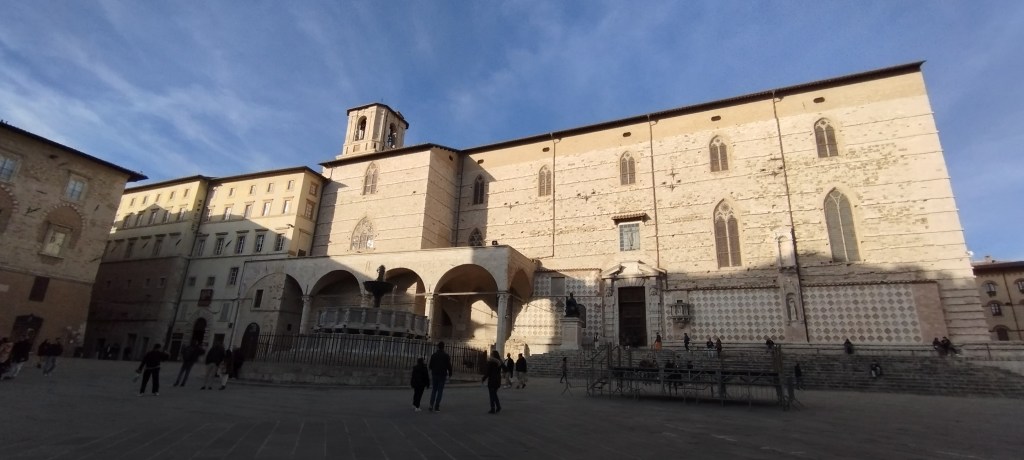
The main façade faces Piazza Danti and is embellished with a Baroque-style portal designed by Pietro Carattoli in 1729. Its edification is linked to the sacrifice of the deacon Lawrence. The church was built in the IX century, but only in 1487 the church was completed. The cathedral boasts emblems of sixteenth-century European paintings.
Below the cloister of the Cathedral of San Lorenzo you enter the Perugia Underground, that is, the Acropolis of Etruscan and Roman Perugia. For millennia, in fact, this place has always hosted the city space dedicated to the divinities. Adjacent to the building is the Archaeological Museum with Etruscan-Roman remains.
Il pozzo etrusco
Among the most iconic works of the past that allow us to admire the immensity of the architectural work of the historical founders of this capital, visit the Etruscan Well, a huge hydraulic work, the Hypogeum of the Volumni, the oldest and most preserved funerary monument of the Etruscan era, and the Etruscan Arch.
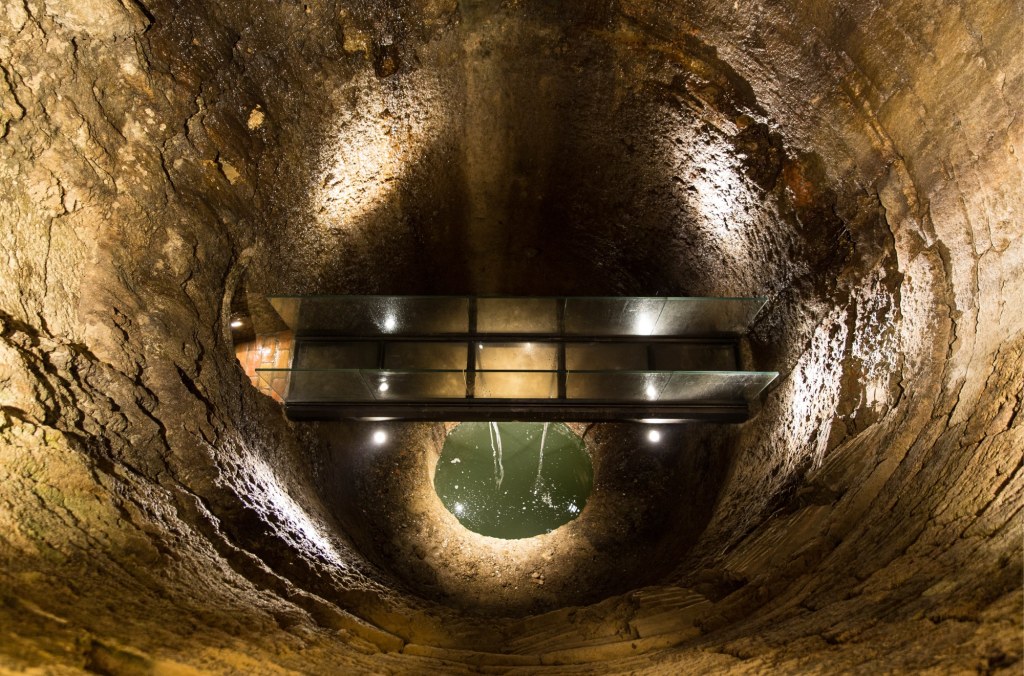
The Etruscan Well is a large hydraulic work that testifies the technical knowledge and the degree of civilization reached by the populations of Perugia as early as 300 years before Christ. It seems that its construction dates back to the IV or III century B.C., but although the date is uncertain, there is no doubt about its dimensions: 37 meters deep and over 5 meters in diameter.
Perugia is extraordinary, and you should go and see it. I will end the article taking into consideration what the writer Karel Čapek quoted :
“Anche Perugia è un sogno, una visione e una Betlemme tra il cielo azzurro e la terra azzurra; una Betlemme un po’ più grande, una cittadina di palazzi e di case fortificate, porte etrusche e vedute stupefacenti.”
 Two Sisters On The Road