There isn’t a more fascinating town in all of central Italy than Assisi, in latin Asisium, a small Umbrian town of about 30,000 inhabitants, a place full of mystery, spirituality, and peace. It is known as the birthplace of Saint Francis of Assisi, patron Saint of Italy. It is the destination of thousands of pilgrims who arrive every year from all over the world to seek that spirituality and faith that we often forget in our life. Numerous are the places of historical, artistic, architectural, and religious interest that can be visited and several are the major monuments that you cannot miss. Visiting Assisi means immersing yourself in the history of Roman and Medieval times, and at the same time entering the heart of spirituality. It’s also the place where two young people changed the history of Christianity.
How to get to Assisi
Assisi can be easily reached by car by taking the exit for Assisi Santa Maria degli Angeli Nord, and it is only two hours away from Rome. If you arrive by train, you can stop at Assisi station, and from there, you can take the local bus. Those coming from further away, the nearest airports are Rome Fiumicino and Perugia. We arrived at Perugia airport and from there we took a taxi that brought us to Assisi. We stayed in Assisi for two days, in a beautiful little hotel called Lieto Soggiorno which was only a few minutes away from the Basilica of Saint Francis and the Basilica of Saint Clare. If you stay in Assisi a couple of days, you don’t necessarily need a car, you can reach everything on foot, and the best way is to walk around the narrow alleys, admire the numerous churches, and the ancient buildings of Medieval times.
What to see in Assisi
The Basilica of St. Francis of Assisi
The first mention inevitably goes to the Basilica of Saint Francis of Assisi, symbol of Assisi and one of the most widespread images in the Christian-Catholic sphere. You cannot go back home without having visited and venerated the immense Basilica. The Basilica of Saint Francis in Assisi is undoubtedly one of the most beautiful and most popular places of worship in all of Christianity, both in Italy and in the whole world.

Indeed, the Basilica of San Francis became part of the UNESCO world heritage list in 2000. The Basilica represents a jewel of Italian art, both in terms of great architecture and painting, thanks to the famous frescoes of well known artists like Cimabue, Simone Martini, Puccio Capanna, Andrea De Bartoli, Giotto, and Girolamo Martelli, just to mention some, who painted the Holiness path of Saint Francis and other Saints, on the walls of the inside of the Basilica. The Basilica is divided into lower and upper parts. In 1228, the construction of what is now the lower church began and it was already finished in 1230, while the upper one was completed in 1253. Even if only a few decades apart, the construction of the two churches bears witness to two different artistic styles. In the lower church, inspired by Umbrian Romanesque, you can admire the works of some of the most important Italian artists, such as Lorenzetti and Cimabue. The architecture of the upper church instead recalls the French Gothic. Both churches were built with the pink stone of Mount Subasio. This is a mountain in the Umbrian-Marche Apennines, located in the province of Perugia; on its western slopes you can find the cities of Assisi and Spello. The Basilica of Saint Francis was built with this very characteristic stone from Mount Subasio. The lower church was designed as a crypt for pilgrims, in fact it still houses the relics of the Saint, while the upper church, airy and brighter, thanks to its larger size was intended to serve as a place of prayers for the monks. As soon as each pilgrim enters the Basilica, as soon as s/he crosses the threshold of this sacred place, s/he experiences a special encounter with the Saint and s/he is amazed by the pictorial majesty of the four “sails” above the high altar, where Giotto represents Saint Francis in glory. The Basilica of Saint Francis is a true architectural marvel.
The Basilica of Saint Clare
The Basilica of Saint Clare is an important place of worship in the historic center of Assisi, as well as a precious historical-artistic testimony. The Basilica is located on the opposite side of the Basilica of Saint Francis, and they stand there as if they were looking at the city to embrace the faithful. The church was built after Saint Clare’s death, between 1257 and 1265. The architectural style is Gothic, and closely resembles the almost contemporary Basilica of Saint Francis of Assisi, the resemblance of the architectural feature of the rose window is clearly evident with the Basilica of Saint Francis. The facade is made of rows of white and pink local stone which comes, from the quarries of Mount Subasio, as well as the one we just mentioned. The relics of the Saint are kept inside the crypt located in a special case made of crystal and pink stone, and it is still possible to visit them.

The Basilica of Saint Clare is located in a magnificent square, called Saint Clare’s square. It strikes the attention of each tourist thanks to its decorations and its grandeur. Furthermore, from the square you can admire a stunning view, which on sunny days, allows you to see the entire Umbrian valley from Montefalco to Perugia. The Church has a Latin cross and is made up of a single central nave, which ends with the transept and the polygonal apse. Inside, it contains precious frescoes created between the XII and XIV centuries. The first two chapels that open on the right represent the oldest area of the building, since they are the remains of the pre-existing Church of San Giorgio. In the first of the two, you can also admire the Crucifix once located in the Church of San Damiano which, according to tradition, invited Saint Francis to work to re-found the Church. The ancient and monumental churches guide the faithful pilgrims along their journeys and the rose windows, the most evocative elements of the facades, enchant visitors thanks to simple light effects.
The Cathedral of San Rufino
The Cathedral of San Rufino is located within the historic center of Assisi. The splendid Romanesque façade stands majestically on the square of the same name. The richly sculpted façade represents one of the highest examples of Romanesque art. The interior, renovated in the XVI century, preserves the baptismal font in which Saint Francis, Saint Clare and, according to tradition, also Frederick II of Swabia were baptized. The church, built in 1029, was awarded the title of cathedral in 1036. In 1140 it was rebuilt based on a design by Giovanni da Gubbio. Pope Innocent IV consecrated it in 1253. The crypt is an environment divided into three naves and preserves fragmentary frescoes from the XI century with Symbols of the Evangelists. The Roman sarcophagus from the III century AD, houses the body of San Rufinus.

Temple of Minerva
The so-called temple of Minerva, of Augustan art, is located in Piazza del Comune in Assisi. It is probably dedicated to Hercules and built in 30 BC. Over time, it was used as a prison, home, shop, council seat and then, in the Middle Ages, transformed into a church with the name of Santa Maria sopra Minerva, with its bell tower, called “Tower of the People”. It appears to be among the best preserved Roman temples of the ancient world. In 1786, Wolfgang von Goethe came to Italy and visited Assisi, and he was enchanted by this wonderful Temple. The facade is perfectly preserved with the six columns that rest on the staircase.

Basilica of Saint Mary of the Angels
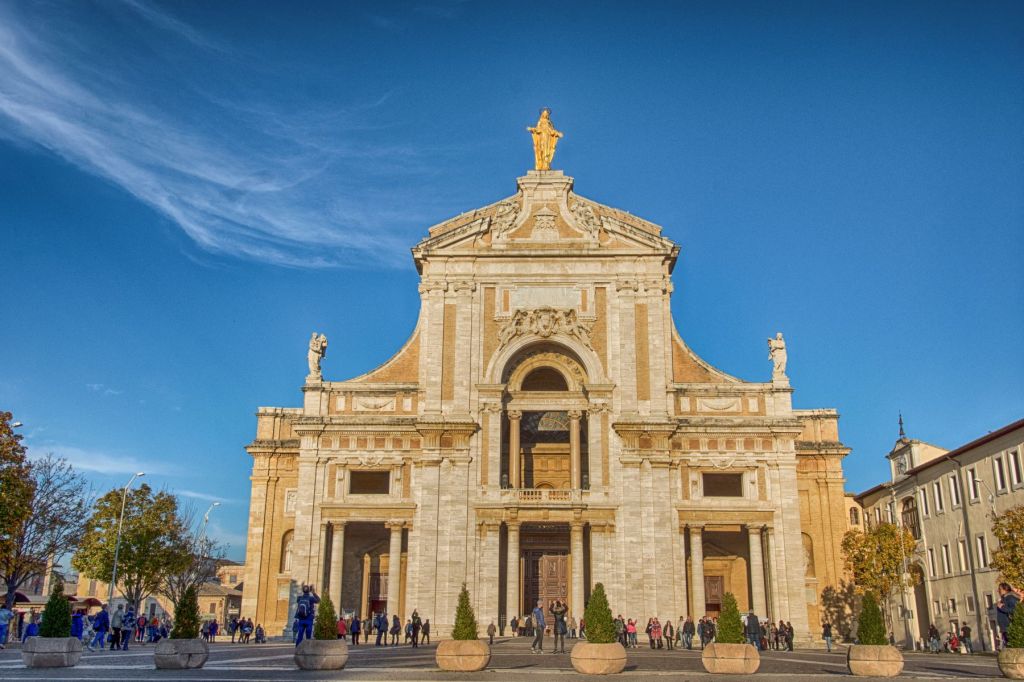
At 4 km from the center of Assisi there is the second church of Assisi linked to Saint Francis: it is the Basilica of Saint Mary of the Angels in Porziuncola built to incorporate and therefore protect some emblematic sites in the life of the Saint. First of all the Porziuncola is a small church where Saint Francis composed the Canticle of the Creatures, and died on October 3rd, 1226. The Canticle of the Creatures is a religious song composed by the Saint. It was written in an Umbrian dialect and It is believed to be the first work of literature written in the Italian language with a known author.
The little church takes its name from “Portiuncula”, which literally indicates the small portion of land on which it stood. This little church was one of the first three to be restored by the Saint who made it the center of Franciscanism. Here he had the vision in which Jesus grants him the Indulgence known as the “Indulgence of the Porziuncola” or “Forgiveness of Assisi”, later approved by the Pope Honorius III.
Finally, a symbolic place full of charm is the Rose Garden that can be found behind the Porziuncola. According to a story, here there were roses in which Saint Francis rolled to fight against doubt and temptation. The plants in contact with the Saint’s body lost their thorns, giving rise to the “Rosa Canina Assisiensis”, which still continues to bloom today only at the Porziuncola. The visit cannot be considered complete without entering the museum which houses a few but extraordinary works of Cimabue, Giunta Pisano, and the work of Andrea della Robbia. In the museum there is also the Conventino, the cells in which the friars lived which today host exhibitions of contemporary sacred art.
Assisi will take you back in time, you will feel regenerated, you will be enchanted by its extraordinary art, you will remain speechless by the narrow Medieval streets, and it will leave you a sense of interior peace.
 Two Sisters On The Road